Mouse Glue Trap Private Label: B2B Buyer's Guide
A practical guide to mouse glue trap private label sourcing from a Chinese factory: board weights, packing, MOQ, OEM steps, limits and what to check before ordering.

TL;DR
- Private label on mouse glue traps is a straightforward OEM job at our factory: you pick board weight (180 g through 230 g), carton count (50 or 100 pcs), artwork and language, and we print and pack to that spec. MOQ is 3,000 pcs per style, and a trial mixed order is accepted so you can test two or three designs before committing.
- The standard board is 258 x 191 mm, the glue is solvent-free pressure-sensitive adhesive with a food-grade attractant, and shelf life is more than 5 years in the original sealed carton kept out of direct sunlight. Those three facts decide most of your landed cost and most of your complaints.
- Glue traps are not a universal product. They perform poorly on damp or dusty floors, they are not suitable where children or pets can reach them, and they are a monitoring and control tool rather than a replacement for sanitation. Sell them with that framing and returns stay low.
Background: why importers ask for private label on glue traps
Glue traps are one of the least glamorous products in the pest control category and one of the most consistently reordered. A distributor in Southeast Asia or the Middle East does not need a brand story. They need a board that stays sticky in their climate, a carton that survives a sea container, and a label in the right language at the right price. That is the whole job.
We have been making adhesives in Chengdu since 2006, added a branch factory in Kunming in 2008, and opened a Yiwu branch and showroom in the Yiwu International Trade Port in 2020. Mouse glue traps sit alongside instant adhesives, epoxy AB adhesives, shoe repair adhesives, fly paper and silicone sealants in our eight product lines. More than 50 export markets, mostly Southeast Asia, Central Asia, South America, the Middle East and Africa, means we have seen which specs hold up in a humid warehouse and which ones fail in a hot container.
Most private label inquiries we get fall into two groups. The first is a distributor who already buys a generic trap and wants their own brand on it to protect margin. The second is an importer building a small household pest range who wants one supplier for traps, fly paper and sealants. Both are workable. Neither is complicated, provided the buyer understands what is actually variable in the product and what is not.
Core definition: what mouse glue trap private label actually means
Private label means the product is manufactured to your specification and sold under your brand. On a glue trap, the variables you control are limited and specific: board weight, board size (our standard is fixed at 258 x 191 mm), carton configuration, printed sleeve or box artwork, language, barcode, and any insert. The adhesive formulation itself is ours and does not change between customers, because reformulating pressure-sensitive adhesive per order is not economical at 3,000 pieces.
That is the honest boundary. You are buying a proven board and putting your name on it. You are not commissioning a new adhesive. If a supplier tells you they will develop a custom glue chemistry for a 3,000-piece order, ask what happens to the batch consistency on the second order.
OEM and private label are used interchangeably in this trade. Both mean your brand, our production. The MOQ is 3,000 pcs per style, and a style means one board weight plus one packaging design. Three designs at 1,000 pcs each is not a 3,000-piece order; talk to us about a trial mixed order instead, which we accept precisely because first orders should be small.
Deep dive 1: board weight is the spec that decides your price and your market
We offer five board weights: 180 g, 205 g, 210 g, 220 g and 230 g. New buyers often treat this as a minor detail. In practice it is the single biggest lever on unit cost and on how the product is perceived in the hand.
A 180 g board is the economy option. It is lighter, it flexes more, and it suits markets where the trap is a low-ticket impulse item sold in a corner shop. A 230 g board feels substantial, lies flatter on uneven floors, and is what most buyers choose when the trap sits on a supermarket shelf next to branded competitors. The 205 g and 210 g grades are the volume middle, and 220 g is a common compromise for buyers who want a heavier feel without the top-tier cost.
A practical note: heavier board is not automatically better for catching mice. What matters is that the board stays flat and the glue stays tacky. A heavy board that warps in transit is worse than a light one that arrives flat. Board weight interacts with how the cartons are stacked and how long they sit in a container, so tell us your route and season and we will tell you what we would ship.
If you are comparing quotes from several factories, compare at the same board weight. A quote at 180 g against a competitor's 230 g is not a like-for-like comparison, and we have seen buyers discover that after the first container. Full board options are listed on our mouse glue trap product page.
Deep dive 2: packing, cartons and the arithmetic of a container
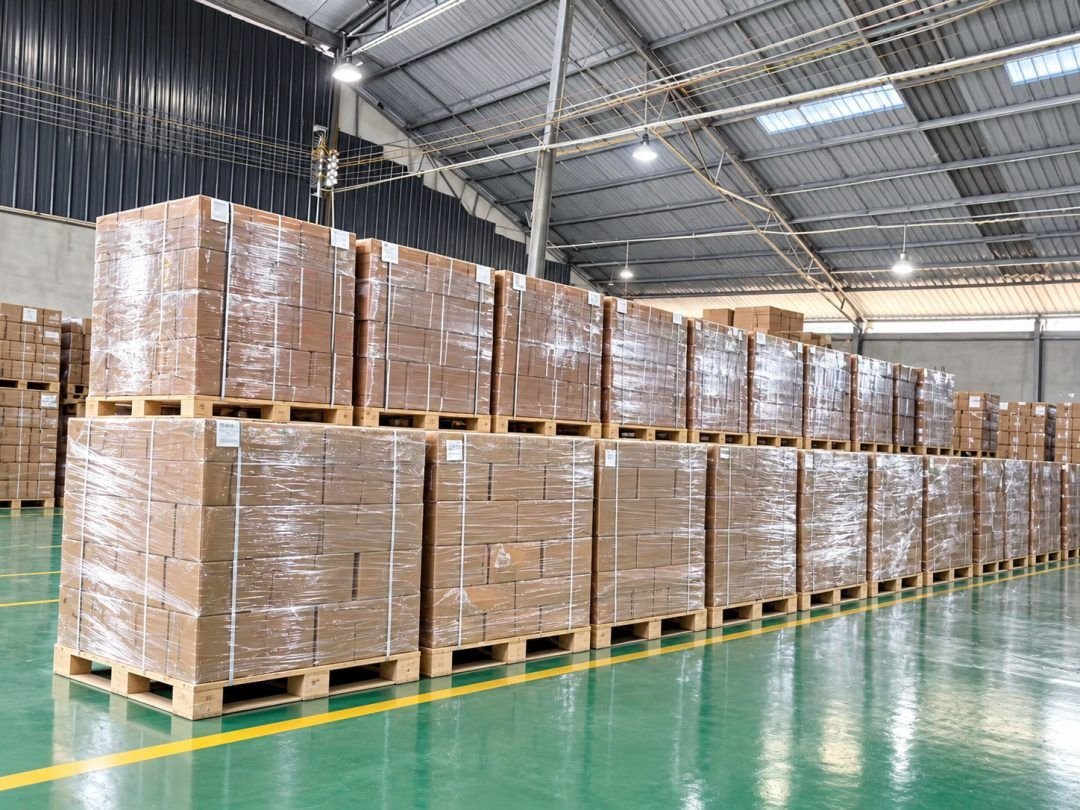
Two carton configurations are standard. The 50-piece carton measures 41.5 x 29 x 28 cm. The 100-piece carton measures 52.5 x 40.5 x 27.7 cm. Neither is exotic; both are sized to stack cleanly on a standard pallet and to stay within manual handling limits that warehouse staff will tolerate.
The 100-piece carton is cheaper per unit on freight and handling, which is why distributors with their own warehouse usually prefer it. The 50-piece carton wins when your customers are small retailers who cannot absorb a hundred traps at once, or when you sell in markets where a smaller outer carton is easier to move through a wholesale chain. There is no universal right answer, and some buyers run both configurations for different channels.
Carton strength matters more than carton size. Glue traps are light but they are stacked, and a container from China to West Africa or South America passes through temperature swings that soften adhesive and stress board. We specify cartons to hold the stack, but you should still plan your own storage: keep cartons sealed, off damp concrete, and out of direct sunlight. Shelf life is more than 5 years in the original sealed carton under those conditions, and that number assumes the carton is intact.
For buyers mixing traps with other products, our OEM/ODM page covers how we handle multi-item orders and artwork approval across several SKUs.
Deep dive 3: the glue, the attractant, and where glue traps genuinely fail
The adhesive is a solvent-free pressure-sensitive glue. It is non-toxic to humans and pets when used as directed, and it contains a food-grade attractant. Those are the two claims that matter most to a buyer, and both come with conditions that a responsible supplier should state plainly.
First, "non-toxic when used as directed" is not the same as "safe anywhere." A glue trap is still a trap. It should not be placed where infants, toddlers or pets can reach it, and a curious cat will get its paw stuck and take the board with it. Retail packaging should carry that warning clearly, in the local language, and importers who skip it are the ones who get the complaints.
Second, glue traps underperform on damp, wet or very dusty floors. Moisture and dust coat the adhesive surface and reduce tack. In coastal markets, or in food-processing facilities that hose down floors, a glue trap is often the wrong tool, and a buyer who positions it as the answer to every rodent problem will see returns. Frame it as a monitoring and control device for dry, sheltered areas, used alongside sanitation and exclusion.
Third, temperature. Pressure-sensitive adhesive softens in heat and stiffens in cold. A container that sits on a dock in summer is not the same product as one that went straight to a climate-controlled warehouse. We cannot control your logistics, but we can advise on shipping windows and storage, and we would rather tell you that now than hear about it after the first claim.
FAQ
What is the minimum order for private label mouse glue traps?
3,000 pcs per style. A style is one board weight plus one packaging design. A trial mixed order is accepted, so you can combine a few designs in one first shipment rather than committing everything to a single SKU.
Can I choose the board weight and carton size?
Yes to board weight: 180 g, 205 g, 210 g, 220 g or 230 g. Cartons are standard at 50 pcs (41.5 x 29 x 28 cm) or 100 pcs (52.5 x 40.5 x 27.7 cm). Board size is fixed at 258 x 191 mm, so artwork must be built to that dimension.
How long can the traps be stored before use?
More than 5 years in the original sealed carton, away from direct sunlight. That assumes the carton stays sealed and dry. Once a carton is opened, treat the remaining boards as normal stock and use them within a reasonable period.
What certificates can you provide?
We hold a CHTC quality management system certificate (ISO 9001), and we can supply MSDS, MA/CMA third-party test reports, the business licence and a certificate of origin with your order. We do not issue certificates we do not hold, so ask for the specific document your customs broker needs before you order.
What is the HS code, and is it the same in every country?
3506.91 is the usual reference for adhesives. It is a reference only. Duty treatment differs by market and by how your broker classifies the product, so confirm with your own broker before you build a landed-cost model.
Buying recommendation
If you are testing the category, start with a 220 g board in the 100-piece carton and a simple printed sleeve. It is heavy enough to feel credible on shelf, the carton is efficient on freight, and the spec is easy to explain to your customers. Order one mixed trial shipment covering two or three artwork variants, sell through a season, then commit to a full container on the winner.
If you already have distribution and know your channel, match the board to the shelf. Economy channels: 180 g or 205 g in 50-piece cartons. Supermarket and pharmacy channels: 230 g in 100-piece cartons with a proper printed box and clear bilingual warnings. Coastal or humid markets: buy the same board but plan storage carefully and brief your customers on placement.
One thing we would push back on: do not buy on unit price alone. Ask each supplier for board weight, carton dimensions and shelf life in writing, and compare those three numbers before you compare the quote. The cheapest board is usually the lightest one, and the lightest one is usually not what your customer expected.
Conclusion
Private label mouse glue traps are a mature, low-drama product. The variables are few: board weight, carton count, artwork, language, warnings. Get those right and the category runs on repeat orders for years. Get them wrong, usually by over-promising on where the trap works, and the returns cost more than the margin.
We have been making adhesives since 2006, we ship to more than 50 countries, and we will tell you when a spec does not suit your market. That is a more useful supplier relationship than a lower quote with a thinner board.
CTA
Send us your target board weight, carton preference, artwork file and destination port, and we will come back with a quotation and a realistic production and shipping window. If you are still deciding, ask for our board weight samples and a spec sheet you can show your own customers. Start at our product range or go straight to OEM/ODM enquiries.